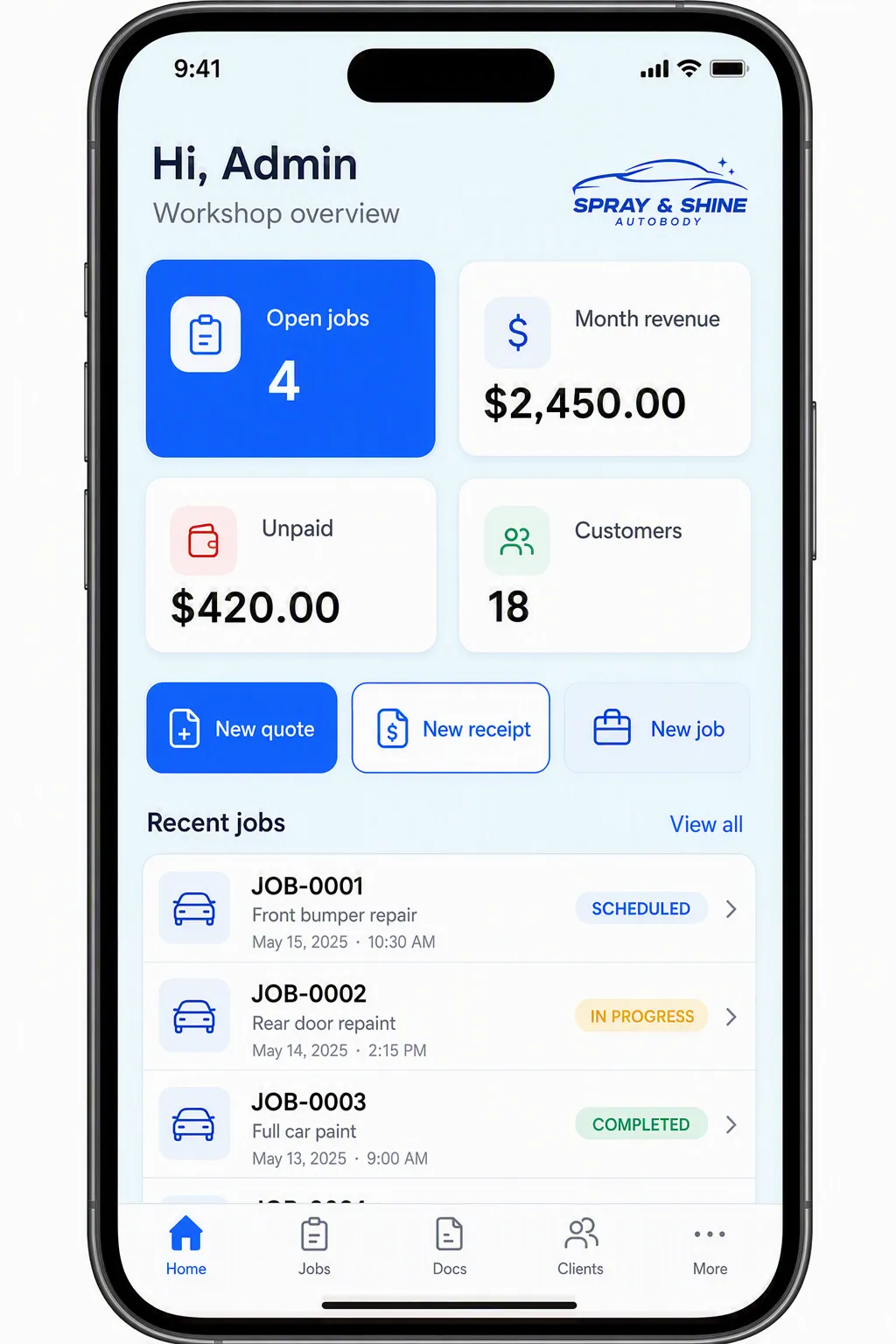
Spray & Shine is a real workshop in Kuwadzana, Harare — and this is the system digitising its paperwork. It replaces quotation books and receipt pads with a workflow that runs from the front counter to the spray booth.
Scope
- Web + API — a Next.js 16 application with a Workshop REST API (Prisma, PostgreSQL, JWT auth) covering quotations, receipts, jobs, clients, expenses, and a gallery
- Mobile — an internal Expo app for the workshop floor: the same jobs and quotations, in the mechanic's pocket
Engineering discipline
This is the most test-covered codebase I run: Jest suites for auth, brand palette, contact/location, financial routes, and the gallery on the web side, plus testing-library on the app. Work is tracked through worktrees, and an audit report (dated 2026-09-17) keeps an honest ledger of what is implemented versus pending — the system is deliberately marked "partially implemented, not ready for production" until the audit clears.
Building for a real workshop means the roadmap is written by the people using it, not by me.
The data model mirrors the workshop
- Roles: ADMIN, CASHIER, TECHNICIAN
- Flow: Customer → Vehicle → Quotation → convert → Job → Receipt (with Payments) → Expense
- Job statuses: DRAFT → SCHEDULED → IN_PROGRESS → ON_HOLD | COMPLETED | CANCELLED
- Service categories: PANEL_BEATING, SPRAY_PAINTING, MECHANICAL, DETAILING, POLISHING, CHASSIS
- Payment methods are Zimbabwean rails: CASH, ECOCASH, ONE_MONEY, INNBUCKS, CARD, BANK_TRANSFER
- Sequential documents: JOB-0001, QUO-0001, RCT-0001, EXP-0001
- Receipt lifecycle: DRAFT | ISSUED | PARTIAL | PAID | VOID
Proven with a smoke test
The delivery spec records a verified end-to-end run: login → create customer → quotation QUO-0001 total $80 → convert to JOB-0001 → receipt RCT-0001 with a partial $40 payment → dashboard shows $40 outstanding. Quotation-to-job conversion started by rejecting DRAFT quotes and now accepts DRAFT/SENT/ACCEPTED with auto-accept — an evolution driven by the counter staff, not by me.
The mobile app
An Expo Router client (NativeWind, TanStack Query, Zustand, SecureStore) with tabs for Home, Jobs, Docs, Clients, and More — quotation-to-job conversion, receipt payment and voiding, and an OS share sheet that's WhatsApp-ready, because that's how Zimbabwean business communicates. Gallery posts upload through ImageKit and power the public gallery API.
Tests as a workshop tool
Jest suites cover auth, brand palette, contact/location, financial routes, and the gallery, plus testing-library on the app. In a shop, a broken financial route isn't an inconvenience — it's money. The system is deliberately marked "partially implemented, not ready for production" in its dated audit report until the audit clears.